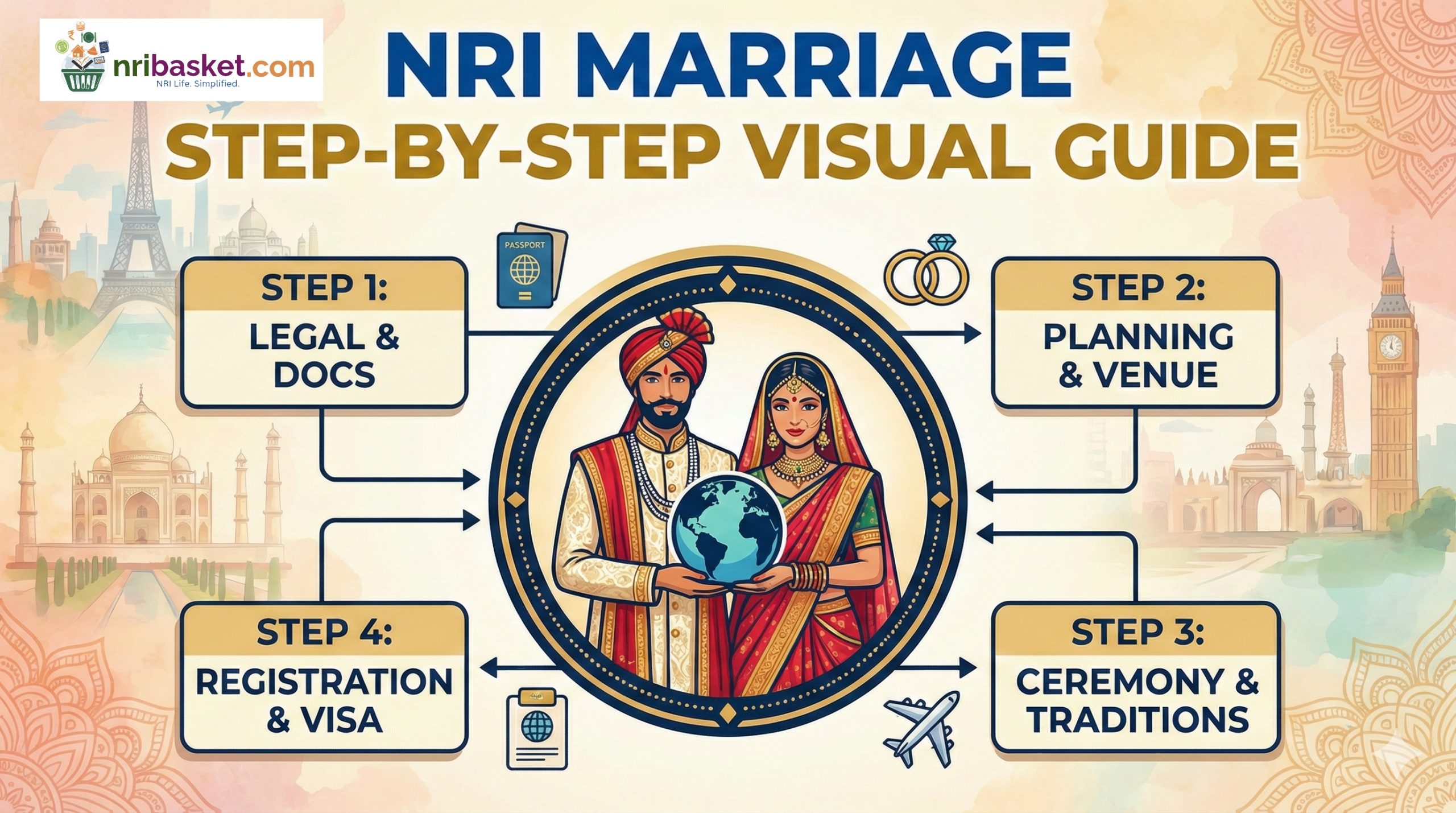
Nri Marriage steps
Step-by-Step: Registering Your Marriage (NRI) — India & Abroad
A concise, phased checklist that shows what to do before, during and after your wedding for legal recognition and immigration purposes.
Confirm legal eligibility
Check age, marital status and any prior legal obstacles.
Ensure both partners meet minimum age requirements and are legally single. If previously married, gather divorce decree or spouse’s death certificate (with apostille/attestation if issued abroad).
Decide legal route & venue
Pick local civil law, religious ceremony, Special Marriage Act, or embassy route.
Choose whether to marry under local country law (civil), under religious rites, and/or register under India’s Special Marriage Act for wider recognition. If one spouse is foreign, Special Marriage Act or local civil marriage plus embassy registration is common.
Prepare core documents
Collect passports, birth certificates, single-status proof and photos.
Typical docs: valid passports, visa/residence proofs, birth certs, passport photos, proof of address, affidavit of single status/bachelorship, divorce decree or death cert (if applicable). Get documents notarized or apostilled as required by the authority where you will register.
Contact the local registrar / embassy
Verify exact requirements and book appointments.
Every country and Indian mission has different forms and timelines. Check the local civil registrar and the Indian embassy/consulate website for appointment slots, fees, witness rules and whether you need a “No Objection Certificate” or single-status affidavit.
Hold the civil / religious ceremony
Perform the marriage as planned — civil formalities first if required.
If you plan a religious ceremony, consider also completing the civil ceremony (where required) so you immediately secure a government-issued marriage certificate from the local authority.
Obtain the local marriage certificate
Ask for the official civil marriage certificate right after registration.
Get the certified marriage certificate from the local registrar — this is the primary legal document. Request multiple certified copies, plus an official certified translation if not in English.
Collect witness IDs & photos
Keep witness IDs and signed forms safe for embassy/India registration.
Ensure the witnesses’ government IDs and signatures are recorded on the certificate. You may need these again for embassy registration or for Special Marriage Act verification in India.
Report marriage at Indian embassy/consulate
File a ‘Report of Marriage’ / consular registration if you married abroad.
Many Indian missions accept a Report of Marriage so that your foreign marriage gets recorded with the Indian mission. They will advise on required docs (certified copy of foreign certificate, passports, photos). This helps with Indian documentation later.
Decide if you’ll register again in India
Choose Special Marriage Act registration or rely on embassy-recorded foreign certificate.
For full legal certainty in India, many NRIs register under the Special Marriage Act (SMA) when they next visit India. SMA provides a domestic Indian certificate; embassy registration alone may not be sufficient for some state-level processes.
Start SMA process (if chosen) — 30-day notice
File a notice at the local Marriage Registrar in India (SMA requires 30 days).
Under the Special Marriage Act you must give a 30-day public notice. The registrar will publish the notice and carry out verification. Plan for travel and presence of both partners and witnesses when the registrar calls for verification or solemnization.
Apostille / Attestation for international use
Authenticate certificates for use in India or abroad.
If a foreign marriage certificate must be used in India (or vice versa), follow the receiving authority’s rules: apostille (for Hague countries) or consular attestation. Check the exact process with the embassy or your registrar to avoid rejections.
Translate & notarize if needed
Get a certified English translation for non-English certificates.
If the certificate is in a foreign language, obtain an official notarized translation. Many government offices only accept English (or official regional language) versions for passports and visa processing.
Update passports & apply for spouse visa
Use the marriage certificate to change surname and apply for dependent visas.
For name changes, follow the passport authority process (local or national). For spouse/dependent visas, attach certified marriage copy, passports and other documents as per the immigration checklist of the destination country.
Update legal & financial records
Notify banks, insurers, PAN, and property registries.
After registration, update bank KYC, PAN, insurance, employer records and property titles (if any). Keep certified copies handy and follow state-specific rules for property transfers or joint ownership changes.
Keep multiple certified copies
Order several certified photocopies and digital scans.
Certified hard copies are often required by immigration/visa/passport offices. Keep at least 5 certified copies, and store high-resolution scanned PDFs in secure cloud storage for quick sharing.
Timeline & scheduling tips
Plan at least 2–3 months ahead if registering in India or abroad.
Factor in 30-day SMA notice, embassy appointment waits, apostille timelines and postal delays. Apply early if you need the marriage certificate for visa deadlines.
Handling special situations
Widows, divorcees, minors, and same-sex marriages — plan accordingly.
If any partner has prior marriage, supply certified divorce decrees or death certificates. For minor-age situations follow local laws. For same-sex unions, confirm current legal status both in India and the country of marriage.
Keep an expert contact
Have a local lawyer or consular contact for tricky cases.
If documentation is complex (e.g., previous marriages, foreign national spouse, translation issues), consult a family-law solicitor or the consular services at the Indian mission to reduce delays or rejection risk.
Quick checklist — Documents to prepare
Passport copies (both partners) — photo & signature page
Proof of address (overseas & Indian, if available)
Birth certificates or DOB proof
Affidavit of single status / no-impediment certificate
Divorce decree / death certificate (if applicable)
Passport photos (as per registrar/embassy specs)
Certified copies of the local marriage certificate
Witness IDs & contact details (3 witnesses recommended)