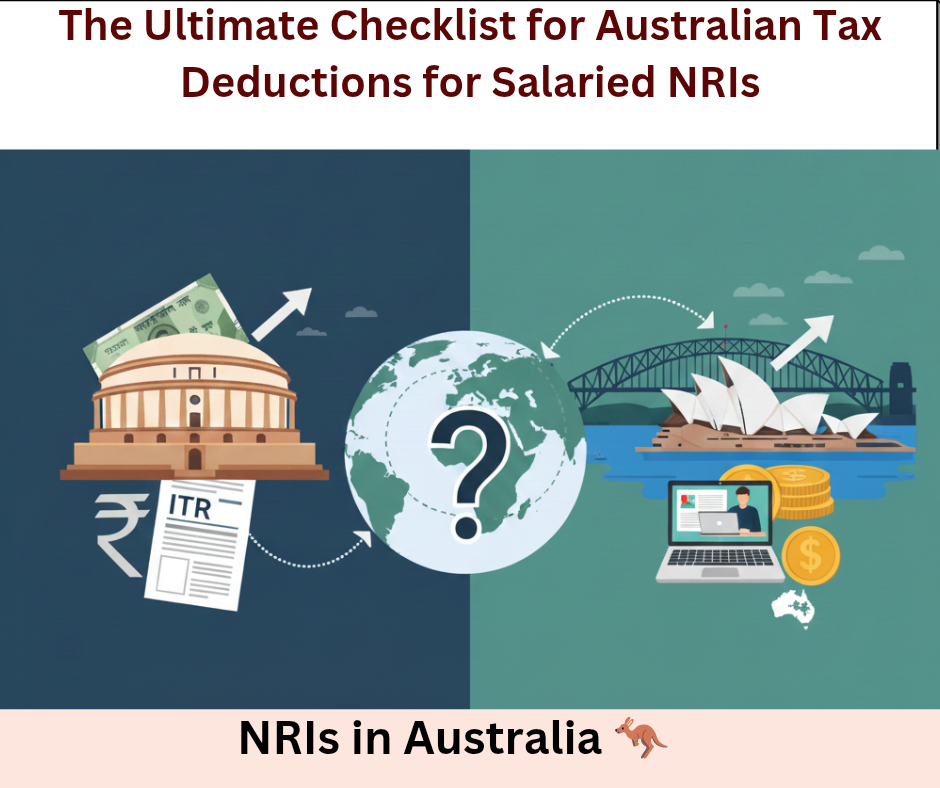
the ultimate checklist for Australian tax
Claiming the right tax deductions can significantly reduce your taxable income in Australia, especially for salaried NRIs who often miss out on eligible benefits due to confusion around ATO rules. From work-related expenses to rental property deductions, investments, overseas income rules, and record-keeping requirements, this ultimate checklist simplifies everything you need to know. Whether you’re a temporary resident, NRI professional, or skilled migrant working in Australia, this guide ensures you maximise every deduction legally while staying compliant with Australian tax laws.
long Answer: In the context of Australian tax, NRI stands for Non-Resident Indian. This refers to an individual of Indian origin who is not considered a resident of Australia for tax purposes. Their tax obligations in Australia will differ from those of Australian tax residents.
long Answer: A “salaried” NRI for Australian tax purposes is an individual who is not a resident of Australia for tax purposes but earns income from employment services performed in Australia. This includes wages, salaries, commissions, and other payments for work done in Australia.
long Answer: The primary difference is that Australian residents for tax purposes are generally taxed on their worldwide income, regardless of where it’s earned. Non-residents, on the other hand, are typically only taxed on income derived from Australian sources.
long Answer: Residency for Australian tax purposes is determined by a set of tests. The primary test is the “resides test,” which considers your usual place of abode. If you don’t pass the resides test, other tests like the domicile test, the 183-day test (spending 183 days or more in Australia), and the Commonwealth superannuation test are applied.
long Answer: Yes, NRIs are required to pay tax in Australia on any income they earn from employment or services performed within Australia. This income is considered Australian-sourced income and is subject to Australian tax laws.
long Answer: A Tax File Number (TFN) is a unique personal reference number issued by the Australian Taxation Office (ATO). While not mandatory for NRIs, it is highly recommended as without one, you will pay tax at the highest marginal tax rate. It also makes it easier to lodge tax returns.
long Answer: Yes, NRIs can claim tax deductions in Australia, but the rules are generally stricter than for residents. Deductions are typically limited to expenses directly incurred in earning their Australian-sourced assessable income.
long Answer: To be deductible, an expense must generally meet three criteria: it must have been incurred in gaining or producing your assessable income, it must not be private or domestic in nature, and you must have a record to prove it.
long Answer: Yes, work-related travel expenses can be deductible if they are directly connected to your employment in Australia and are not for private purposes. This could include travel between different workplaces, or to attend work-related conferences or training. However, travel between home and your regular workplace is generally not deductible.
long Answer: You may be able to deduct self-education expenses if the course or training directly relates to your current employment in Australia and helps you to maintain or improve the skills or knowledge needed for your job, or results in a likely increase in your income. It generally cannot be for a new job or to obtain a new qualification if it does not directly relate to your current role.
long Answer: Fees paid to professional associations, trade unions, or similar organizations are generally deductible if your membership is necessary for your employment or directly relates to earning your employment income.
long Answer: Home office expenses can be deductible if you genuinely work from home as part of your employment and incur additional expenses as a direct result. This generally requires a dedicated area for work and can include a portion of utilities, depreciation of office equipment, and internet costs, calculated based on the portion used for work.
long Answer: You can claim deductions for the cost of purchasing, cleaning, and maintaining uniforms or protective clothing if they are specific to your job, are compulsory, and bear a company logo (for uniforms), or protect you from illness or injury at work (for protective clothing).
long Answer: The cost of tools and equipment you use for work can be deductible. If the item costs more than XXX, you generally claim depreciation over its effective life. If it costs XXX or less, you can claim an immediate deduction. You must own the item and use it for work purposes.
long Answer: Keeping accurate records, such as receipts, invoices, and logbooks, is crucial. The ATO requires you to be able to substantiate your claims. Without adequate records, the ATO may disallow your deductions, and you could face penalties.
long Answer: Salaried NRIs are subject to non-resident tax rates, which are generally higher than resident tax rates and usually do not include a tax-free threshold. This means tax is payable from the first dollar of income earned in Australia.
long Answer: Unlike Australian residents who typically benefit from a tax-free threshold, non-residents for tax purposes generally do not have a tax-free threshold. This means that tax is applied to all Australian-sourced income from the first dollar.
long Answer: A PAYG Payment Summary (now often called an Income Statement via Single Touch Payroll) is an annual statement provided by your employer showing your gross income and the amount of tax withheld from your pay during the financial year. This document is essential for accurately completing and lodging your Australian income tax return.
long Answer: NRIs can lodge their Australian tax return online through the myGov portal linked to the ATO, or by using the services of a registered tax agent. Using a tax agent can be particularly helpful for navigating the complexities of non-resident tax rules.
long Answer: The general deadline for lodging individual income tax returns in Australia is October 31st following the end of the financial year (which runs from July 1st to June 30th). If you use a registered tax agent, you may be eligible for an extended deadline.
long Answer: NRIs who are not eligible for Medicare benefits are generally exempt from paying the Medicare levy. You typically need to apply for a Medicare levy exemption.
long Answer: If an NRI owns a rental property in Australia that is genuinely available for rent, they can generally claim deductions for expenses related to that property. This includes interest on loans, property management fees, council rates, insurance, repairs and maintenance, and depreciation.
long Answer: A Double Tax Agreement (DTA) is a treaty between two countries (e.g., Australia and India) designed to prevent individuals from being taxed twice on the same income. For NRIs, a DTA can specify which country has the primary right to tax certain types of income, potentially reducing their tax liability in Australia or India.
long Answer: Yes, Australia and India have a comprehensive Double Tax Agreement (DTA) in place. This agreement helps to clarify taxing rights between the two countries and can provide relief from double taxation for residents of either country earning income in the other.
long Answer: If the amount of tax withheld from your salary by your employer (PAYG withholding) is more than your actual tax liability as calculated in your tax return, you will be eligible for a tax refund. This is a common outcome for many NRIs.
long Answer: Failing to lodge a tax return when required can result in penalties from the ATO, including fines. It can also create issues with your tax record, potentially impacting future visa applications or your ability to return to Australia for work or residence.
long Answer: As an NRI, you are generally only taxed on your Australian-sourced income. Therefore, you do not typically need to declare income earned overseas unless it has an Australian source or connection, or if you later become an Australian tax resident.
long Answer: This is a complex area, but in some limited circumstances, expenses incurred overseas could be deductible if they are directly and necessarily related to earning your Australian-sourced employment income. For example, if you undertook a specific training course overseas that was a compulsory requirement for your Australian job. It’s best to seek professional advice for such claims.
long Answer: For further assistance, you can refer to the official Australian Taxation Office (ATO) website, which provides extensive information. It is also highly recommended to consult with a registered Australian tax agent or a professional tax advisor who specializes in non-resident tax matters for personalized advice.
long Answer: If your residency status for tax purposes changes during the financial year (e.g., you arrive in Australia and become a resident, or leave and become a non-resident), you will be treated as a “part-year resident.” This means different tax rules and thresholds apply for the resident and non-resident portions of the year. It’s crucial to correctly identify your residency period and seek guidance if unsure.
Australian tax deductions for NRIs, tax deductions for salaried NRIs, ATO deductions checklist, NRI tax return Australia, Australian tax refund tips, work-related deductions Australia, rental property deductions Australia, NRI tax guide Australia, overseas income tax Australia, temporary resident tax rules, migrant tax checklist Australia, Australia NRI finance, maximise tax return Australia