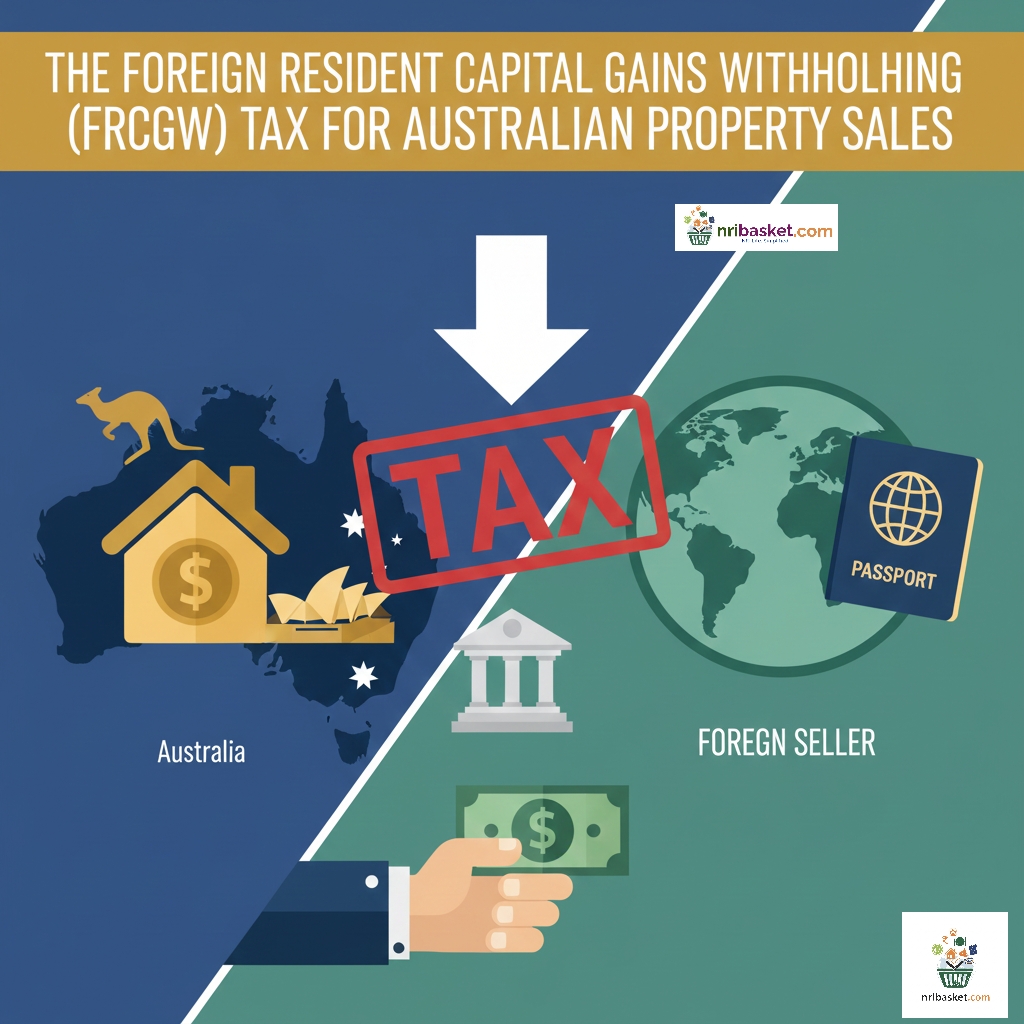
The Foreign Resident Capital Gains Withholding (FRCGW) Tax for Australian Property Sales
Decoding the Foreign Resident Capital Gains Withholding (FRCGW) Tax for Australian Property Sales
understand your obligations and avoid common pitfalls
FRCGW tax Australia for NRIs, Australian property tax non-residents, Capital Gains Withholding Australia, ATO clearance certificate, foreign resident property sales Australia, FRCGW changes 2025, selling Australian property as a non-resident, FRCGW FAQs, Australian real estate tax, non-resident capital gains tax.
The landscape of Australian property ownership for foreign residents, particularly Non-Resident Indians (NRIs), has undergone significant changes with the evolution of the Foreign Resident Capital Gains Withholding (FRCGW) tax. This mechanism, designed to ensure foreign residents meet their capital gains tax obligations, has seen substantial updates, especially those effective from January 1, 2025. Understanding these rules is crucial for anyone involved in selling Australian real property to avoid unexpected withholdings and ensure a smooth transaction.
The FRCGW regime is not an additional tax but rather a withholding obligation placed on the purchaser of Australian property. This means a portion of the sale proceeds is withheld at settlement and remitted directly to the Australian Taxation Office (ATO) as a prepayment towards any potential capital gains tax liability. This system helps the ATO collect tax from foreign residents who might otherwise be difficult to pursue once they leave Australia. The recent changes, particularly the removal of the AUD$750,000 threshold and the increase in the withholding rate to 15%, signify a broader application of these rules, impacting a wider array of transactions and emphasizing the need for comprehensive understanding among all parties involved in Australian property dealings. These adjustments aim to further strengthen the integrity of Australia’s tax system concerning foreign investment in real estate.
Long Answer: FRCGW is a system introduced by the Australian government to ensure foreign residents comply with their Australian capital gains tax (CGT) obligations when they sell certain Australian assets. It requires the purchaser of the property to withhold a percentage of the sale price and pay it directly to the ATO at settlement. This mechanism acts as a prepayment of the vendor’s eventual capital gains tax liability, reducing the risk of non-payment by foreign residents.
Long Answer: The FRCGW was introduced to assist in the collection of capital gains tax liabilities from non-residents who dispose of Australian assets, making it easier for the ATO to secure tax payments that might otherwise be difficult to recover once a foreign resident leaves the country. It addresses concerns about the compliance of foreign vendors with their tax obligations on capital gains derived from Australian assets.
Long Answer: The FRCGW payments regime first came into effect on July 1, 2016. Initially, it applied to real property sales with a contract price of AUD$2 million or more, with a withholding rate of 10%. These parameters have been adjusted multiple times since its inception to broaden its scope.
Long Answer: From January 1, 2025, significant changes have been implemented: the withholding rate has increased from 12.5% to 15%, and the AUD$750,000 property value threshold has been removed. This means the 15% withholding now applies to all real property transactions involving foreign residents, regardless of the property’s value. This expansion makes the FRCGW applicable to a much larger number of property sales.
Long Answer: A “foreign resident” refers to an individual or entity who is a non-resident for Australian tax purposes. This determination is based on a set of residency tests outlined by the ATO, which consider factors such as physical presence, domicile, and the intention to reside in Australia. It’s crucial to understand that tax residency can differ from immigration or citizenship status.
Long Answer: Yes, Australian citizens living overseas who are considered foreign residents for tax purposes are impacted. If they sell Australian property, the FRCGW rules apply to them. Their Australian citizenship does not automatically grant them Australian tax residency if they meet the criteria for being a foreign resident under tax law.
Long Answer: FRCGW applies to “Taxable Australian Real Property” (TARP), which includes residential and commercial properties, vacant land, mining or resource rights, leases over land, and indirect Australian real property interests (such as shares in companies that derive more than 50% of their value from Australian real property). This broad definition ensures comprehensive coverage of assets closely linked to Australian land.
Long Answer: For contracts signed on or after January 1, 2025, the withholding rate is 15% of the sale price. This rate is a direct increase from previous years and applies across the board with the removal of the property value threshold.
Long Answer: For contracts signed up to and including December 31, 2024, the withholding rate was 12.5%, and it only applied to properties valued at AUD$750,000 or more. This prior threshold meant that many lower-value properties were exempt from the withholding regime, which is no longer the case.
Long Answer: No, FRCGW is not an additional tax. It is a prepayment of your Capital Gains Tax (CGT) liability, which is reconciled when you lodge your annual tax return. The withheld amount acts as a credit against your eventual tax bill; if the actual CGT is less than the withheld amount, a refund will be issued.
Long Answer: The purchaser of the property is responsible for withholding the FRCGW amount and remitting it to the ATO. This places a significant obligation on the buyer and their legal representatives to ensure compliance.
Long Answer: Failure to withhold the required FRCGW amount can result in penalties and interest being levied on the purchaser. The ATO can recover the unpaid withholding amount from the purchaser, making it a critical aspect of due diligence for buyers.
Long Answer: A clearance certificate is a document issued by the ATO that confirms a seller is an Australian resident for tax purposes. Australian resident vendors must obtain and provide this certificate to the purchaser before or at settlement to avoid the withholding tax. It is the primary means by which an Australian resident vendor can prevent the FRCGW from being applied.
Long Answer: No, a foreign resident (non-resident for Australian tax purposes) cannot obtain a clearance certificate. These certificates are specifically for Australian tax residents to declare their residency status to the ATO and the purchaser.
Long Answer: Foreign residents can apply for a “variation notice” from the ATO, which may allow for a reduced withholding rate if their actual capital gains tax liability is lower than the standard 15%. This often happens if there are significant capital losses or if the property was acquired at a high cost, resulting in a smaller gain.
Long Answer: A clearance certificate is generally valid for 12 months from the date of issue. It is important for vendors to ensure their certificate is current at the time of settlement. If the settlement is delayed, a new certificate may be required.
Long Answer: While most clearance certificates are issued within a few days for Australian residents, the ATO states that the process can take up to 28 days. It is advisable to apply well in advance of settlement to avoid delays and complications. Applications can be made online through the ATO’s portal.
Long Answer: If an Australian resident vendor does not provide a valid clearance certificate by settlement, the purchaser is legally required to withhold 15% of the sale price and pay it to the ATO. The vendor will then need to claim this back through their annual tax return, potentially causing cash flow issues.
Long Answer: The seller must lodge an Australian tax return at the end of the financial year, declaring their Australian assessable income, including any capital gain from the property sale. They can then claim a credit for any withholding amount paid to the ATO, and a refund will be issued for any overpaid amounts. Accurate record-keeping is essential.
Long Answer: A Tax File Number (TFN) is a unique identification number issued by the ATO. Foreign resident vendors will need a TFN to lodge an Australian tax return and claim credit for any FRCGW withheld. It is also required for applying for a variation notice.
Long Answer: Yes, certain transactions are exempt, such as sales conducted through an approved stock exchange, sales involving vendors under external administration or bankruptcy, securities lending arrangements, and some CGT-exempt transfers like certain deceased estates. However, the general rule is broad, so exemptions are relatively specific.
Long Answer: No, foreign nationals are generally not eligible for the main residence exemption for capital gains tax purposes. This exemption typically allows Australian residents to disregard capital gains on the sale of their primary home, but this benefit was removed for foreign residents from XXX.
Long Answer: Yes, FRCGW can apply to inherited property if the beneficiary is a foreign resident and sells the property. Executors may need to apply for clearance certificates on behalf of the estate if the deceased was an Australian resident, or the FRCGW rules will apply to the foreign resident beneficiary upon sale.
Long Answer: Indirect Australian real property interests include assets like shares in companies or interests in trusts which primarily derive their value from Australian real property. These are also subject to FRCGW, requiring thorough due diligence to determine if the 15% withholding applies to the sale of such interests, especially when the underlying assets are substantial.
Long Answer: Yes, it is possible to apply for a variation notice that results in a 0% withholding rate if the capital gains tax payable is nil, for example, due to significant capital losses, or if other exemptions or specific circumstances result in no tax liability on the gain. This needs to be approved by the ATO.
Long Answer: The names on the clearance certificate must accurately match the names on the property’s Certificate of Title. If there’s a name mismatch, proof of name change (e.g., marriage certificate, change of name deed) should have been provided to the ATO when applying for the certificate. Discrepancies can lead to the purchaser still withholding the funds.
Long Answer: Yes, each vendor, including those in joint tenancy, will generally need to provide a separate clearance certificate if they are Australian residents. The ATO assesses residency status for each individual, and a joint certificate is not typically issued.
Long Answer: No, a conveyancer generally cannot apply for a clearance certificate. It must be completed by the vendor or their authorized agents, such as a solicitor or tax agent. It is often recommended to engage a tax agent due to the complexities of tax residency.
Long Answer: The FRCGW is typically calculated on the sale price or the market value if the transaction is not at arm’s length. Even if the sale price is lower than market value in a non-arm’s length transaction, the withholding will likely be based on the market value, to prevent tax avoidance.
Long Answer: It is highly recommended to consult with a legal professional or a tax advisor specializing in Australian property and tax law to ensure compliance with FRCGW rules and to discuss your specific circumstances. The ATO website also provides detailed guidance and forms. Seeking professional advice is crucial to navigate the complexities and avoid potential financial penalties.