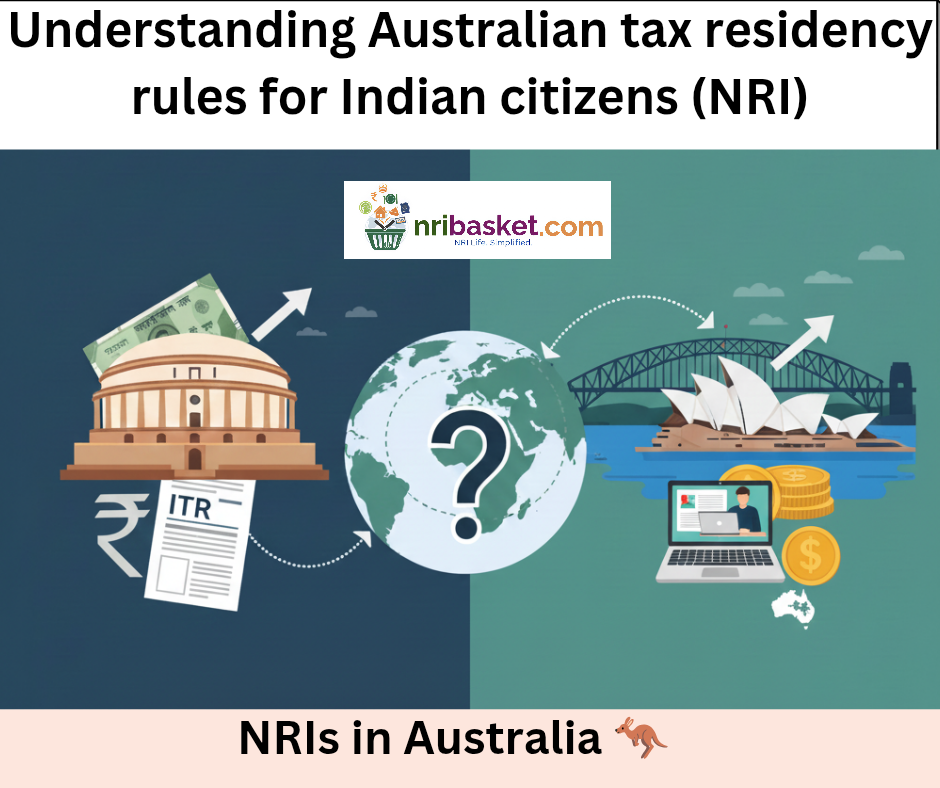
understanding Australian tax residency
Introduction
Understanding Australian tax residency rules for Indian citizens is extremely important, especially if you work, study, or live between India and Australia. Your tax status decides how much tax you pay, which income is taxable, and whether you need to lodge an Australian tax return.
This guide explains the 2024 ATO tax residency rules in simple language—so NRIs, students, migrants, temporary visa holders, or frequent travellers can know exactly where they stand.
Long Answer: Tax residency is not about your passport—it’s based on your living situation. If the ATO considers Australia your home, you are a tax resident. Residents pay tax on global income; non-residents pay tax only on Australian-sourced income.
Long Answer: The ATO does not provide special rules for Indian citizens. Your residency depends on how long you stay, your purpose (study/work/migration), where your home is, and your ties—not your nationality or passport.
Long Answer: ATO uses:
1) Resides Test,
2) Domicile Test,
3) 183-Day Test, and
4) Commonwealth Superannuation Test.
If you pass any one test, you are a tax resident.
Long Answer: ATO reviews where you live, your daily routine, family location, job, and lifestyle. If you “live” in Australia in a settled manner, you are a resident even without staying 183 days.
Long Answer: Even if you travel abroad, if your main home, family, or intention is to stay in Australia long-term, you pass this test. For Indian migrants settling in Australia, this test often applies immediately.
Long Answer: This test applies when you stay in Australia for more than half the year, unless your usual home is clearly overseas and you don’t plan to stay in Australia permanently.
Long Answer: If you stay in Australia for a long-term study program (1 year or more), rent a place, and live a normal student life, you are generally considered a resident for tax purposes.
Long Answer: Your visa does not decide your residency. Your lifestyle, duration of stay, and living arrangements decide it. Most long-term workers and graduates are tax residents.
Long Answer: Short visits do not meet residency tests. If you are not living, studying, or working in Australia, the ATO treats you as a non-resident.
Long Answer: Residents pay tax on worldwide income, including Indian salaries, rent, interest, and capital gains. Non-residents pay tax only on income sourced in Australia.
Long Answer: Indian rental income must be added to your Australian return if you are a tax resident. You can claim foreign tax credits for tax paid in India under the DTAA treaty.
Long Answer: If a PR lives in Australia and has a home, job, and family here, the ATO treats them as tax residents. But the rule still depends on actual living arrangements.
Long Answer: If both countries treat you as a resident, the DTAA tie-breaker rules will determine your final residency for tax purposes based on your permanent home, vital ties, and habitual residence.
Long Answer: When you migrate, the ATO looks at your intention, housing, family, job, and lifestyle. On satisfying residency conditions, you may also have CGT implications on assets you owned before moving.
Long Answer: Many workers come alone first. If you rent a home, work full-time, and intend to stay long-term, you may still qualify as a tax resident even if your family is overseas.
Long Answer: Your residency starts when you form a settled pattern of life—renting a home, enrolling in study, starting work—not immediately on arrival unless you move with a clear permanent intention.
Long Answer: Owning property alone is not enough. ATO checks where you actually live. But a home in Australia supports the idea that Australia is your usual place of residence.
Long Answer: Even if income is paid in India, your physical location determines tax rules. Residents pay tax on worldwide income, including remote Indian jobs.
Long Answer: Tourists are non-residents. If they earn money/">money from Australian sources (like a short gig or investment income), they must pay non-resident tax rates.
Long Answer: Non-residents pay tax from the first dollar earned. They also cannot claim certain offsets. This makes understanding residency extremely important.
Long Answer: If you hold a temporary visa and are not married to an Australian citizen/PR, you may not need to declare most overseas income except employment income earned overseas.
Long Answer: Even non-residents must lodge a return for any Australian-sourced income (jobs, interest, property, investments).
Long Answer: If you move back to India or another country, close your home, job, and personal ties in Australia, you may become a non-resident again.
Long Answer: Keeping a bank account does not make you a resident. ATO checks your actual living arrangements, not financial accounts.
Long Answer: The ATO can access border movement records to cross-check how long you stayed in Australia when applying the 183-day test.
Long Answer: Residency depends on your living situation, not your salary. Even low-income students or part-time workers can be residents.
Long Answer: You cannot select your residency. The ATO decides based on facts. Claiming non-residency incorrectly can cause penalties.
Long Answer: If you move to Australia with a plan to stay long-term (study/work/migrate), this strongly supports tax residency even before completing 183 days.
Long Answer: Evidence like rental agreements, university enrolment, utility bills, TFN, Medicare card, and bank statements help demonstrate your settled life in Australia.
Long Answer: Review where you live, how long you stay, your ties, your visa, and your future intentions. If unsure, seek ATO guidance or tax advice, especially if you earn in both Australia and India.
Australian tax residency for Indian citizens, ATO tax residency rules NRI, Australian tax resident test, NRI Australia tax, overseas income tax Australia, Indian citizen tax residency, tax residency Australia for students, temporary resident tax rules Australia, ATO residency tests 2024